
Could Someone Steal Your House? This Free Virginia Alert Can Help Protect You

You probably don't spend much time worrying about someone stealing your house. After all, it's not as though a thief could simply pick it up and carry it away. But there's another kind of property theft that doesn't involve breaking a window, changing the locks, or even setting foot on your property.
It's called deed fraud, and it occurs when someone uses forged or fraudulent documents to make it appear as though they own your property or have a legal claim to it.
While deed fraud isn't an everyday occurrence, the consequences can be serious. Fortunately, Virginia homeowners have access to a free service that can help them discover suspicious activity involving their property before the situation becomes more complicated.
How can someone steal a house on paper?
When you purchase a home, the deed establishing your ownership is recorded with your local circuit court clerk's office. This creates a public record of the transaction.
Unfortunately, criminals can sometimes exploit this recording process by creating fraudulent documents that appear to transfer ownership of someone else's property. A scammer might, for example, forge a homeowner's signature on a deed and attempt to record it as though the property had been legally sold or transferred.
In other cases, criminals may use fraudulent documents to attempt to borrow against property they don't own.
Recording a fraudulent deed doesn't automatically make the criminal the rightful owner of your home. However, it can create a cloud on your title, meaning there's a question about who legally owns the property. Clearing up the situation may require legal assistance, considerable paperwork, and time.
Vacant properties, rental homes, and properties owned by people who live elsewhere can be attractive targets because suspicious activity may go unnoticed longer. But any property owner could potentially be affected.
A free alert can help you spot suspicious activity
Virginia's court system offers a service called VADeed Alert, which allows property owners to receive email notifications when certain documents are recorded in local land records.
The service is free, and you don't have to wait for something suspicious to happen to enroll.
Once registered, you can enter your name or your property's Tax Map/Parcel Identification Number (PIN). When a document containing information that matches your registered criteria is recorded in a participating circuit court's land record, the system sends you an email notification.
For example, suppose you've owned your home for 20 years and have no plans to sell it or borrow against it. If you suddenly receive an alert about a newly recorded document involving your name or property, you'll have an opportunity to investigate.
The notification doesn't necessarily mean something is wrong. There are legitimate reasons for documents to be recorded against a property. But knowing about an unexpected filing gives you a chance to ask questions before a potential problem grows.
Virginia has also taken steps to expand access to these protections. Under legislation enacted in 2026, circuit court clerks with electronic land-record filing systems must establish free property-alert notification systems beginning July 1, 2027. Some localities already offer their own notification services, so availability and enrollment procedures may vary.
How to sign up for VADeed Alert
Getting started is straightforward:
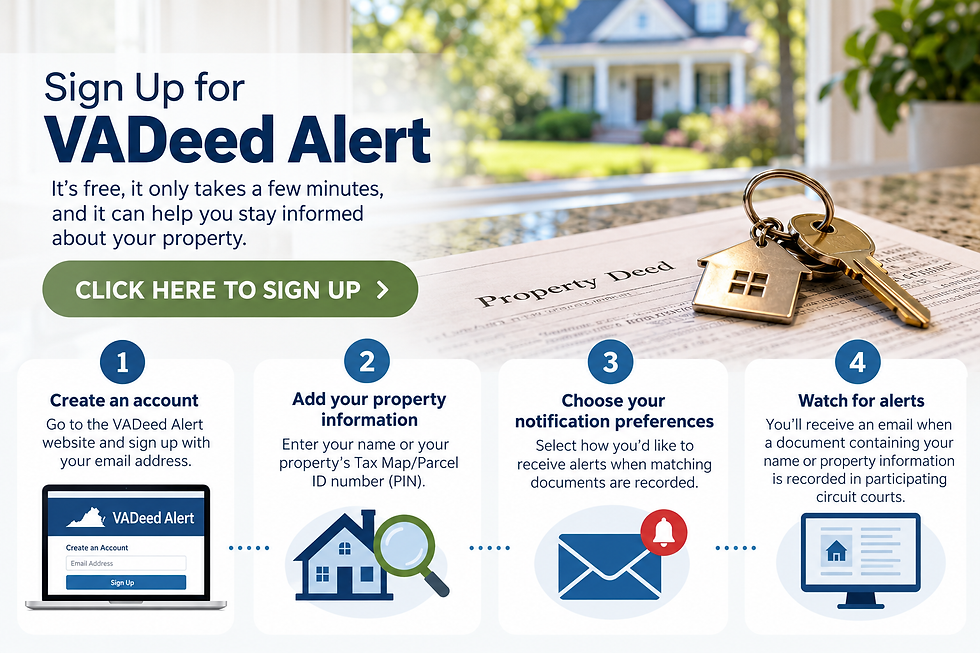
It's worth registering any variations of your name that might appear on property documents. For example, if your deed includes your middle initial but you sometimes use your full middle name, registering both versions may help you recognize more activity.
If you own more than one property, you can also register additional identifying information to help monitor those properties.
Your property's Parcel ID number can generally be found on your real estate tax assessment or through your city or county's real estate assessment website.
If VADeed Alert isn't available for your locality, contact your circuit court clerk's office to ask whether another free property-notification service is offered.
What should you do if you receive an unexpected alert?
First, don't assume that every notification signals fraud. A recorded document might involve a legitimate transaction or simply contain a name that matches yours. If you don't recognize the activity, contact your circuit court clerk's office to learn more about the document and how to obtain a copy.
If the filing appears fraudulent, contact local law enforcement promptly and consider speaking with a Virginia real estate attorney. If the document involves a mortgage or other financial claim, you may also need to contact the lender or financial institution involved.
It's important to understand that the alert system doesn't prevent someone from filing fraudulent paperwork, and the clerk's office cannot automatically resolve an ownership dispute. The service is designed to help you discover potential problems sooner so you can take appropriate action.
A little awareness can go a long way
Most homeowners carefully protect their keys, monitor their bank accounts, and keep important documents in a safe place. But few think about monitoring the public records associated with their homes.
A property alert adds another layer of awareness without requiring much effort. Once you've enrolled, the system can help keep you informed about recorded documents that match your registration information.
And because the service is free, it's an easy precaution worth considering, whether you've just purchased your first home or have lived in the same house for decades.
Take a few minutes to explore VADeed Alert or contact your local circuit court clerk to find out which free property-alert services are available where you live.
Read more from our sources:
Virginia Court System — VADeed Alert: Official Registration and Service Information
Supreme Court of Virginia, Office of the Executive Secretary — VADeed Alert: Property Fraud Notification Service
Virginia General Assembly — Code of Virginia § 17.1-258.3:1: Property Alert Electronic Notification System
City of Richmond Circuit Court Clerk's Office — Deeds: Enroll Now in VADeed Alert to Protect Yourself from Deed Fraud
Virginia Court System — Online Services: VADeed Alert


Comments