
How AI Can Help You Prepare for Severe Weather
- 2 hours ago
- 3 min read
Practical ways homeowners can use artificial intelligence before, during, and after a storm.

If severe weather is in the forecast, there is no substitute for paying attention to official forecasts and emergency alerts. Artificial intelligence cannot predict the future or replace guidance from the National Weather Service or your local emergency management office.
AI can help you prepare more efficiently.
Whether you're organizing your emergency supplies, creating a last-minute checklist, understanding weather terminology, or documenting damage afterward, AI can act as a knowledgeable assistant that helps you save time and stay organized.
Here are several practical ways homeowners can use AI before, during, and after severe weather.
Before the Storm
1. Build a Storm Preparation Checklist
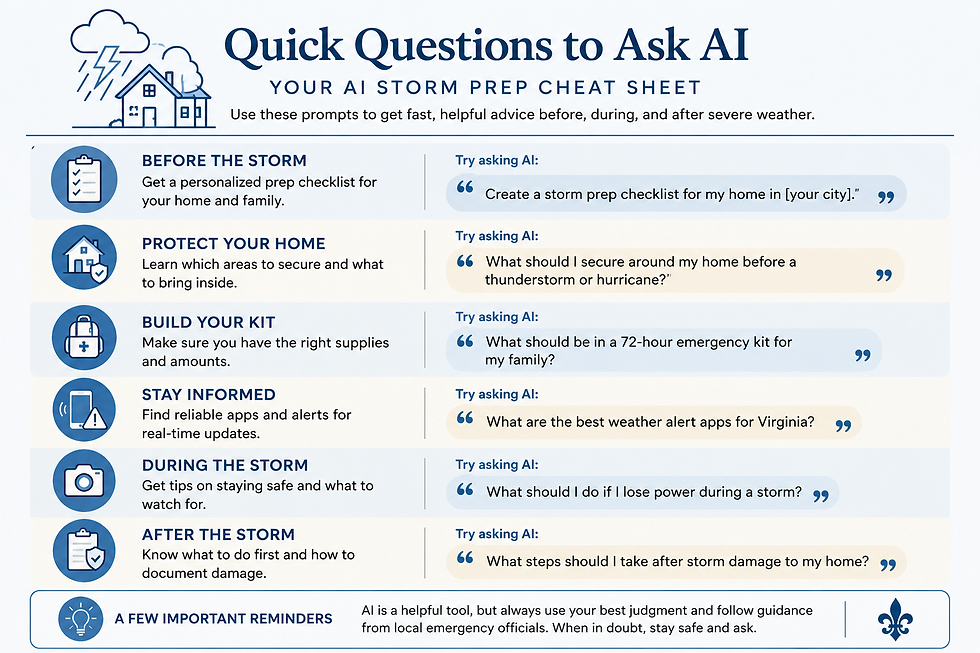
Instead of searching multiple websites, ask AI to create a customized checklist tailored to your situation.
Example prompt:
"I own a two-story home in Virginia with a finished basement. A severe thunderstorm is expected tomorrow. Create a preparation checklist for me."
AI can help organize reminders such as:
Bringing in outdoor furniture
Charging phones and backup batteries
Testing flashlights
Securing patio umbrellas
Moving vehicles under cover if hail is possible
Checking gutters and nearby tree branches
Locating important documents
Always compare the checklist against recommendations from trusted organizations such as Ready.gov or your local emergency management office.
2. Understand the Forecast
Weather alerts often include unfamiliar terminology. Rather than guessing what they mean, ask AI to explain them in plain language.
Examples:
"What does a Severe Thunderstorm Watch mean?"
"What's the difference between a watch and a warning?"
"What does a 60% chance of hail mean?"
AI can simplify weather terminology while you continue following forecasts from the National Weather Service.
3. Check Your Emergency Supplies
AI can help you compare what you already have with recommended emergency kits.
For example:
"Here's what's in my emergency kit..." (paste your list)
"What important items am I missing for a household of four?"
You can also take a picture of the supplies you have, if they are in one location, and input it into an AI like Chat GPT, and ask it to tell you what is missing. You will need to give it a comparison point to help.
For example:
"Based on this image, make a list of the important emergency kit items am I missing for a household of four compared to a standard 72-hour emergency kit.
This can save time when preparing for an approaching storm.

During the Storm
4. Stay Informed
Continue relying on official weather information from:
National Weather Service
NOAA Weather Radio
Local television meteorologists
Local emergency management agencies
AI can complement—not replace—these sources.
For example:
summarize lengthy weather discussions
explain technical terms
help you understand forecast updates
If you have a smart speaker such as Amazon Alexa or Google Assistant, you can also ask for weather updates or enable severe weather notifications from supported weather services.
5. Ask Questions as Conditions Change
If power remains available, AI can answer practical questions such as:
"Is it safe to run my generator this way?"
"How long should refrigerated food stay cold during a power outage?"
"What should I inspect after large hail?"
Always verify safety-related advice with trusted sources, especially if it involves electricity, generators, flooding, or structural damage.
After the Storm
6. Create a Damage Documentation Plan
Once it's safe, AI can help you organize the recovery process.
Ask:
"Create a room-by-room checklist for documenting storm damage for insurance purposes."
It can suggest photographing:
Roof damage (from a safe location)
Siding
Windows
Trees
Fences
Outdoor structures
Interior water damage
Personal belongings
Remember that AI should not determine whether damage is covered under your insurance policy.
7. Organize Photos and Notes
Many homeowners take dozens—or even hundreds—of photographs after severe weather.
AI can help:
Organize photo descriptions
Create chronological notes
Draft repair questions
Build contractor comparison lists
Prepare a timeline of events
Keeping organized records can make recovery less stressful.
A Few Important Reminders
Artificial intelligence is most helpful when paired with reliable information.
When severe weather threatens:
Follow National Weather Service warnings.
Pay attention to local emergency officials.
Never rely solely on AI for life-safety decisions.
Verify important information before acting.
Think of AI as another tool in your emergency preparedness kit—not a replacement for official guidance.
Continue Learning
Preparing for severe weather is just one way AI can simplify homeownership.
Visit our AI for Homeowners Resource Center to explore additional guides on using AI safely, choosing helpful tools, and getting more value from today's technology.
Learn more from our Sources:
Ready.gov – Build a Kit and Severe Weather Guidance
National Weather Service (weather.gov)
NOAA Weather Prediction Center
FEMA
National Oceanic and Atmospheric Administration (NOAA)
American Red Cross – Emergency Preparedness


Comments