
Repair or Replace? How AI Can Help You Decide

Your dishwasher has stopped draining, your air conditioner needs another expensive repair, or a contractor has suggested replacing all your windows when you thought a few repairs might do. Deciding whether to repair something or replace it can be one of the more frustrating parts of owning a home, particularly when the expense is substantial. A repair might save money today, but will it last? Replacing something may solve the problem, but could you be spending thousands of dollars unnecessarily? |
Artificial intelligence (AI) can help you work through these questions before making a decision. Tools such as ChatGPT, Gemini, and Claude can help you investigate problems, understand repair options, research replacement costs, compare products, and prepare questions for contractors.
You don't need to know much about the equipment or even have a clear idea of what's wrong. Just tell AI what you know and let the conversation develop from there.
The following sections offer a practical way to approach the decision, whether you're dealing with a broken appliance or a major home improvement. You can follow them in order or skip ahead to the information that's most useful to you.
Start With What You Know
When something in your home needs attention, you probably know more about the situation than you realize. You may not know the age of your dishwasher or why your windows are drafty, but you know what you've noticed, what has changed, and perhaps something about the history of the item.
That's enough to begin a conversation with AI.
Tell it what you know about the problem, the appliance or system, and anything else that seems relevant. Then ask what additional information would help it understand your situation.
For example, suppose your dishwasher isn't working properly.
Try this prompt:
"My GE dishwasher came with the house, so I don't know how old it is. Lately, it hasn't been draining properly, and it's making more noise than before. Can you help me figure out what's going on? What else would you need to know?"
AI might ask whether an error code is showing, whether the noise occurs during washing or draining, or whether you know the model number. If you don't know where to find the model number, you can ask AI to help you locate it.
The conversation might be quite different if you're concerned about your windows.
Try this prompt:
"My house still has its original wood windows, and I've noticed drafts around several of them. I'm wondering whether they need to be repaired or replaced. What else would you need to know?"
AI might ask whether the windows open and close properly, whether you've noticed moisture or deterioration around the frames, or whether the drafts seem to come from the windows themselves or the surrounding trim.
Or perhaps you're dealing with a relatively new refrigerator.
Try this prompt:
"I have a Samsung refrigerator that we bought two years ago. It's built into the kitchen cabinetry and has panels that match the cabinets. The icemaker keeps freezing up. Can you help me understand what might be happening, and what else do you need to know?"
In this case, AI might suggest identifying the exact model, checking warranty coverage, and finding out whether the problem has been reported with similar refrigerators. The refrigerator's age and specialized installation could also become important if replacement enters the discussion.
Notice that none of these questions requires you to know technical specifications, repair costs, or the cause of the problem. You're simply starting with the information you have.
Photos can help fill in the gaps
You can upload photographs to many AI assistants, which is particularly useful when you don't know what something is called.
For example, if you can't identify your dishwasher's model, photograph the manufacturer's label and ask AI to help read it. You can also photograph an error code, a damaged window frame, or a part you don't recognize.
AI may be able to help you identify the equipment, locate the manufacturer's manual, or explain what you're looking at.
Keep in mind that AI sometimes misreads labels or misidentifies equipment, so verify model numbers and technical information before relying on them.
Explore What Might Be Wrong
Once AI understands the general situation, you can begin investigating possible causes and solutions.
Let's return to the dishwasher that isn't draining properly and has become noisier.
AI might explain that standing water can result from a clogged filter, an obstruction in the drain line, or a malfunctioning drain pump. It may also ask questions to help narrow the possibilities.
Ask AI:
"Which of these problems could I safely check myself before calling a repair technician?"
AI might suggest checking an accessible filter or looking for an obvious kink in the drain hose, depending on the dishwasher model.
If you discover that the filter is clogged and cleaning it resolves the problem, your investigation may be finished. There's no reason to research replacement costs.
But suppose the filter is clean and the dishwasher still won't drain. You could ask:
"Could the noise and drainage problem be related? What would a repair technician typically check?"
This may help you understand what to expect when you call for service and whether a particular repair sounds reasonable.
The same approach works with larger home systems. If you're concerned about drafty windows, AI can explain the difference between air leaking around the frame, deteriorated weatherstripping, damaged wood, and problems with the glass itself.
Some of these issues may be relatively inexpensive to correct, while others require more extensive repairs or replacement.
ENERGY STAR identifies air sealing, including caulking and weatherstripping, as ways to improve a home's comfort and energy efficiency. Replacing the entire window isn't always necessary to address a draft. |
Remember: AI can suggest possible causes, but it cannot reliably diagnose a problem without the appropriate inspection and testing. Follow manufacturers' instructions and leave electrical, gas, refrigerant, structural, and other potentially hazardous work to qualified professionals.
Find Out Whether It's Worth Repairing
Once you have a better understanding of what might be wrong, the next question is whether repairing the item makes sense.
Age matters, but it shouldn't be the only consideration. A relatively new appliance with a minor problem may have many useful years ahead of it. An older appliance that has already needed several expensive repairs presents a different situation.
AI can help you research how long a particular appliance or home system typically lasts and which factors affect its useful life.
Suppose your air conditioner is 12 years old.
Ask AI:
"My air conditioner is 12 years old. How much longer might it reasonably last, and what should I consider before paying for another repair?"
AI may ask about the type of system, its maintenance history, previous repairs, and whether it still cools your home effectively.
You can provide the information you know and ask AI to help research anything you don't.
When does ENERGY STAR recommend considering replacement?The Environmental Protection Agency's ENERGY STAR program identifies several signs that it may be time to have heating and cooling equipment evaluated for replacement:
|
These are reasons to consider having your equipment evaluated, not automatic replacement deadlines. A well-maintained system may continue working effectively beyond these ages, while a newer system may have problems that justify replacement.
Uneven temperatures can also result from ductwork, insulation, or airflow problems rather than the heating or cooling equipment itself.
Don't overlook warranty coverage
Before authorizing a repair, particularly on a newer appliance, find out whether it's covered by a manufacturer's warranty, an extended warranty, or a service agreement. Remember the two-year-old Samsung refrigerator with the troublesome icemaker? Warranty coverage could make repairing it considerably more attractive than replacing it.
If you have the warranty document, you can upload it and ask AI to help you understand the coverage, exclusions, and steps for requesting service.
Ask AI:
"Here's the warranty for my refrigerator. Can you help me understand whether an icemaker problem might be covered and what I should do next?"
AI can help explain warranty language, but the manufacturer or warranty provider must confirm whether your particular repair is covered. You may also want to ask AI to help you check for manufacturer service notices or recalls affecting your exact model.
Understand What the Repair Will Cost
Once you have an idea of the problem, AI can help you research what repairs typically cost and understand the estimates you receive.
Suppose a technician tells you that your dishwasher needs a new drain pump. Before agreeing to the repair, you could ask:
"What is the typical cost of replacing a drain pump in a GE dishwasher, including parts and labor? Can you help me find current estimates for my area?"
AI can research published repair-cost ranges and explain why prices vary. Labor rates, the availability of parts, the complexity of the repair, and your location can all affect the final cost. These figures won't replace an actual estimate, but they can help you understand whether the proposed cost appears reasonable.
Have AI explain your estimate
Contractor and repair estimates sometimes contain unfamiliar terms or technical descriptions that aren't especially helpful to homeowners. You can upload a written estimate and ask AI to explain it in plain language.
For example:
"Can you explain what this estimate includes and tell me if there's anything I should ask the contractor before agreeing to the work?"
AI might point out that the estimate doesn't specify whether parts are new or refurbished, whether labor is guaranteed, or whether additional charges could apply. If you have estimates from two companies, AI can also help you compare them. This is particularly useful for larger repairs, where two contractors may recommend different approaches or include different work in their proposals.
Before uploading documents, remove personal information such as account numbers, unnecessary contact details, or other information you don't want to share.
Research Replacement Costs and Options
Even if you're leaning toward repairing something, knowing what a replacement would cost gives you a better basis for comparison. AI can help you research current prices, identify products that meet your needs, and estimate additional expenses such as installation, delivery, removal of old equipment, or modifications to your home.
Find out what larger projects typically cost
Suppose a contractor recommends replacing 15 windows in your home.
Ask AI:
"What is the typical price range for replacing 15 wood windows in a home in Richmond, Virginia, including professional installation?"
AI can help you research published local and regional price ranges, as well as the factors that affect costs. From there, you might ask:
"How would the price differ if I used vinyl or fiberglass windows instead of wood?"
Or:
"Would repairing my existing wood windows and adding storm windows be worth considering?"
This gives you a better understanding of the possible costs and alternatives before you begin collecting estimates.
Be sure to ask AI for recent information and sources. Costs can vary substantially depending on your home's condition, the materials selected, installation requirements, and local labor rates. Published price ranges are useful for planning, but they aren't substitutes for detailed contractor estimates.
Let AI help you shop for a replacement
Shopping for a new appliance can be time-consuming, particularly when you have specific size requirements or features you don't want to give up. AI can help you narrow the choices much more quickly than searching through dozens of individual product listings.
Suppose you've decided that your dishwasher may need replacing.
Ask AI:
"Can you help me shop for a new dishwasher? I'd like to find models that will fit in the same space as my current GE."
AI may ask for the model number or dimensions.
As the conversation continues, you can add your preferences:
"I'd like to stay under $900, and I really want a third rack for silverware rather than just a basket."
AI can help you identify models that meet those requirements, compare features, and look for current prices and retailers. You might then ask about reliability, noise levels, energy efficiency, warranty coverage, or consumer reviews. The same process works for refrigerators, washing machines, water heaters, and other household equipment.
For a refrigerator, you may need to consider door clearance, available depth, ventilation requirements, and whether the existing cabinet panels can be reused. AI can help you research these details before you spend time visiting stores.
Always confirm product dimensions, installation requirements, availability, and prices with the retailer or manufacturer. AI shopping information isn't always current, and not every recommended product will necessarily meet all your requirements.
Compare Repairing and Replacing
Now that you have a better understanding of the problem and the likely costs of each option, AI can help you make a more meaningful comparison. You may have heard the advice that if a repair costs more than half the price of replacement, you should buy new. While this can be a useful starting point, it doesn't account for the age of the equipment, its condition, or how long a repair might reasonably extend its life.
Consider a 12-year-old air conditioner that needs a $900 repair. A contractor has quoted $6,000 for a replacement. At first glance, repairing it seems considerably less expensive, but what if the system has already required several repairs? What if your energy bills have increased, or what if a new system could significantly reduce your operating costs?
These are questions AI can help you explore.
Ask AI:
"My 12-year-old air conditioner needs a $900 repair. A replacement would cost $6,000. Can you help me compare the two options?"
AI may ask about the nature of the repair, the system's maintenance history, or its efficiency rating.
As you provide more information, you can ask it to estimate the financial impact of each choice over the next five years.
For example:
"If the repaired air conditioner lasts another five years, how would that compare financially with replacing it now?"
AI can organize the information and perform calculations, although any projection depends on assumptions about future repairs, energy costs, and the remaining life of the equipment.
Look beyond the initial price
Here's how the options might compare:
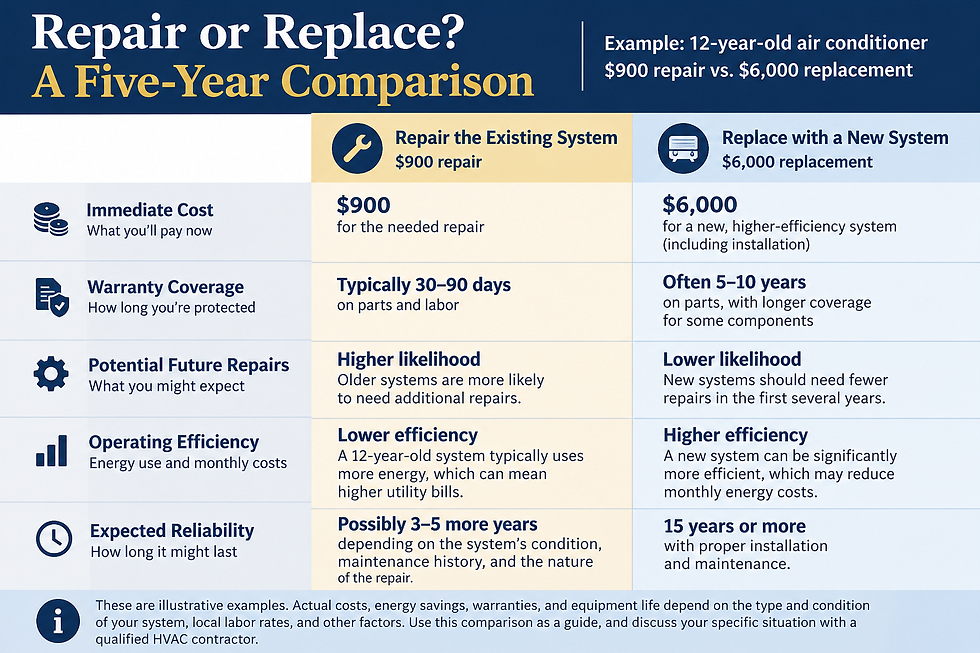
One important consideration is energy efficiency. Newer appliances and HVAC systems may consume less energy than older models, which can reduce operating costs. However, energy savings don't necessarily justify replacing something that's still working well. You can ask AI to help estimate the difference using the efficiency ratings of your existing equipment and a proposed replacement, along with your local utility rates.
You may discover that replacing an inefficient system makes financial sense. Or you may find that even with potential energy savings, repairing the existing equipment is the more economical choice.
The goal isn't to have AI choose for you. It's to understand what you're getting for your money.
Consider What Matters Most to You
The least expensive choice isn't always the best one for your household. You might have a refrigerator that fits perfectly into cabinetry designed around it. Replacing it could involve more than simply purchasing another appliance.
Perhaps your original wood windows contribute to your home's character, and you'd prefer to preserve them if repairs can make them comfortable and energy-efficient.
Or you may be willing to spend more on a dishwasher because you've become accustomed to its quiet operation or a particular feature.
These preferences can influence whether repairing or replacing something makes sense.
Sometimes the real problem is something else
Let's return to our homeowner with the aging air conditioner. During the conversation about replacement costs, you remember something else that's bothered you for years: one bedroom is always warmer than the rest of the house. You might ask:
"One bedroom is always warmer than the others. Would replacing my air conditioner solve that problem?"
AI may explain that uneven temperatures can result from ductwork issues, insulation problems, airflow restrictions, or equipment that isn't properly sized.
ENERGY STAR recommends addressing major air leaks and ductwork problems before investing in new heating and cooling equipment, since these issues can be responsible for poor comfort and energy performance. |
You could then ask:
"What should I have my HVAC contractor check before deciding whether to replace the system?"
This is a good example of how an AI conversation can change the direction of your investigation.
What began as a question about spending $900 or $6,000 has led to a more important question: Will replacing the equipment actually solve the problem?
Tell AI what matters to you
You can bring personal preferences into almost any repair-or-replace discussion.
For example:
"I'd really prefer to keep my original wood windows if possible. What repair or improvement options should I investigate?"
Or:
"I don't want to replace my washing machine unnecessarily, but I also don't want to keep paying for repairs. How should I think about that?"
AI can help you explore these priorities alongside the financial considerations. This is one reason a continuing conversation is more useful than simply asking AI for an immediate recommendation. As you learn more, you may remember details or develop preferences that change what makes sense for your home.
Get a Second Opinion When You Need One
When a contractor recommends an expensive replacement, it's reasonable to want to understand why.
This doesn't mean the contractor is wrong. An experienced professional may recognize problems that aren't obvious to a homeowner, and replacement may genuinely be the most economical or reliable solution.
But before committing to a major expense, you may want to understand the alternatives. Suppose a window contractor recommends replacing every window in your house because several are drafty.
You could ask AI:
"A contractor recommends replacing all my windows, but only some are drafty. What questions should I ask about repairing them instead?"
AI may suggest asking whether the frames are deteriorating, whether air leakage can be corrected, or whether the contractor has considered weatherstripping, glass repairs, or storm windows. You can also ask AI to explain the advantages and disadvantages of the proposed materials or installation methods.
For older homes, preserving existing windows may be particularly important, and there are circumstances in which repairs and weatherization can improve performance without requiring complete replacement.
ENERGY STAR offers guidance on both window replacement and air sealing, recognizing that the appropriate improvements depend on the home's condition and the problems being addressed. |
Prepare for another contractor's visit
If you're getting a second estimate, AI can help you prepare questions based on what the first contractor recommended.
Ask AI:
"Here's what the first contractor recommended. What should I ask the second contractor to help me compare their recommendations?"
This can be especially helpful for roofing, HVAC, foundation, and other major projects where the proposed work may differ considerably between contractors. You can also upload both estimates and ask AI to compare the scope of work, materials, warranties, and exclusions.
AI cannot determine whether a contractor's diagnosis is correct or whether a quoted price is fair simply by reading an estimate. It can, however, help you understand what you're being asked to approve and where you may need more information. If the work involves a significant safety concern or risk of property damage, don't delay necessary professional attention while researching alternatives.
Make Your Decision With Confidence
By this point, you may have learned more about your appliance or home system than you expected.
Perhaps AI helped you identify a relatively simple repair. Maybe you discovered that your equipment is approaching the end of its expected life, or that replacing it would cost considerably more than you anticipated. You may also have learned about options you hadn't considered, such as repairing original windows, choosing a different type of heating system, or purchasing an appliance with features better suited to your household.
Before making your decision, you can return to the same AI conversation and ask:
"Based on everything we've discussed, what else should I consider before deciding?"
AI can review the information you've shared, summarize the advantages and disadvantages of each option, and identify any remaining questions. You can also ask it to create a simple comparison table or summarize what you've learned so you can discuss it with a contractor or another member of your household.
Ultimately, the decision is yours. AI can't guarantee how long a repair will last, predict every future expense, or replace the judgment of a qualified professional. It can, however, help you approach an expensive decision with a clearer understanding of your options.
You don't have to know where to begin
One of the most useful things about AI is that you don't need to know the right questions before starting a conversation. You don't have to understand how your air conditioner works, know the model number of your dishwasher, or be familiar with the different types of replacement windows.
Just explain what you know, in your own words, and ask AI what else would be helpful. If it asks a question you can't answer, simply say, "I don't know. Can you help me find out?" You may be surprised by how much you can learn from a conversation that begins with something as simple as, "My dishwasher isn't working. Can you help me figure out what to do?"
Continue LearningThis article is part of our growing AI for Homeowners Resource Center, where you'll find practical guides, AI tool reviews, homeowner checklists, and prompt libraries designed to help you use artificial intelligence with confidence. Be sure to bookmark the Resource Center and check back often as new articles and resources are added. |


Comments